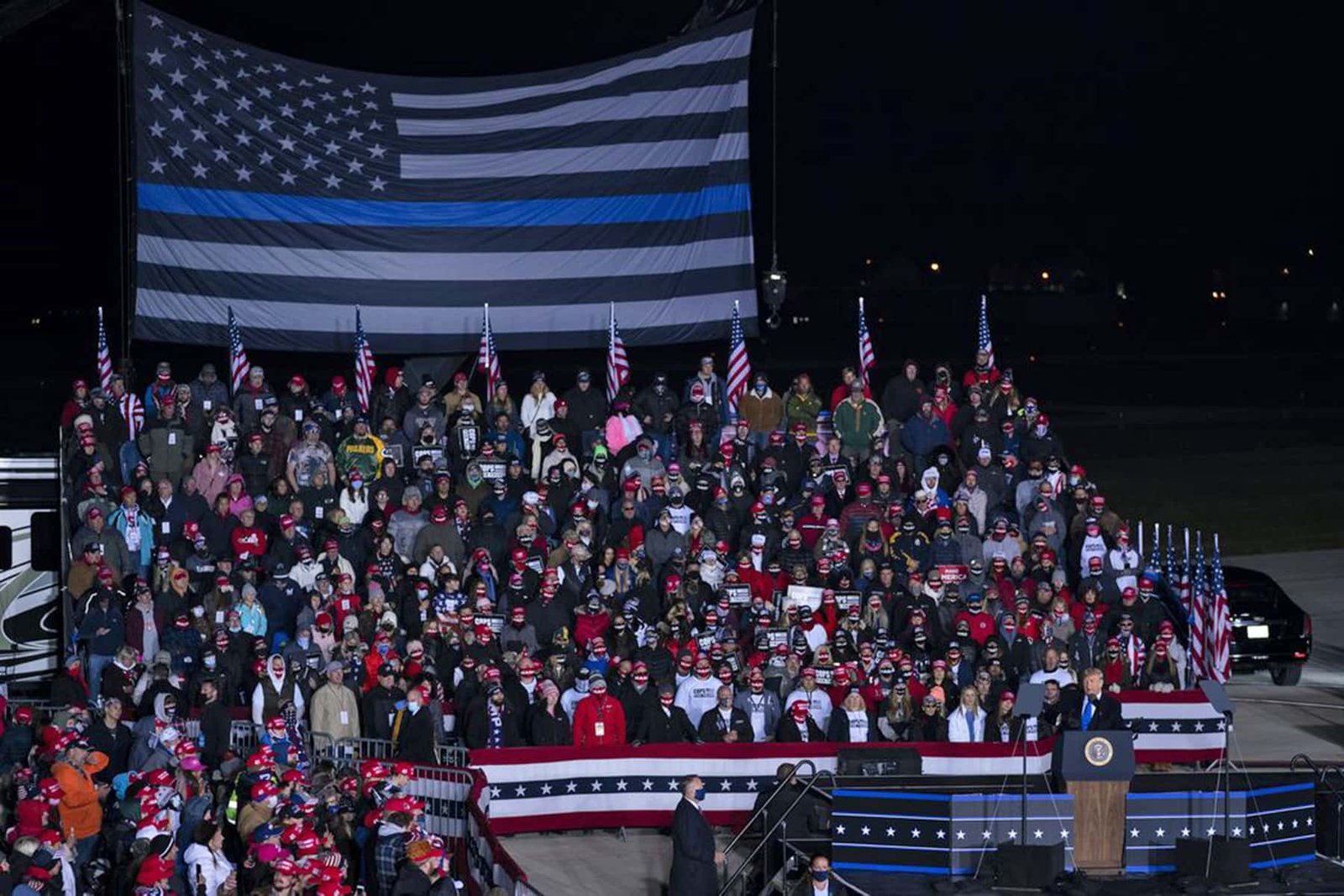
On September 25, the Office of the President published a new directive, National Security Presidential Memorandum 7 (NSPM-7), that outlines a plan to ‘disband and uproot’ organizations. On the surface, it’s about national security. But a closer look reveals a systematic playbook for manufacturing a crisis and turning state power against political opponents.
Abusing Power to Disrupt the Opposition in a Zero-Sum Political Environment
Political actors and aligned media can manufacture a false sense of crisis by fabricating and amplifying narratives of widespread chaos and violence, such as “cities being burned to the ground”. This constant messaging creates a false belief among their followers that the opposition constitutes an existential threat, thereby gaining public support for extreme or tyrannical state actions.
This manufactured perception of necessity is then used to justify radical state actions, such as deploying the military for domestic law enforcement, as supporters, convinced of the crisis, will praise these acts as necessary for restoring safety and order. This is happening in the United States right now.
NPSM-7 directs a coordinated effort across multiple federal agencies to “disband and uproot”1 organizations identified as promoting organized violence and dissent.
The directive explicitly orders law enforcement to actively dismantle networks, entities, and organizations. It mandates the involvement of a wide range of federal bodies, including:
- the Joint Terrorism Task Force,
- the Department of Justice,
- the Department of Homeland Security,
- the Treasury, and the Internal Revenue Service.2
The multi-agency approach suggests the use of not just criminal prosecution but also financial and administrative tools to pressure and disable opposition groups. It cites existing statutes and codes as the legal basis for these actions, implying a plan to weaponize current laws against political opponents. To use the power of government in such a manner, the case must be made that this is a necessary use of government authority.
NSPM-7 manufactures the perception of a unified conspiracy by listing disconnected violent events and presenting them as evidence of a single, coordinated plot. It cites a range of specific incidents:
- assassination attempts on political figures (e.g. Kirk, Trump, Kavanaugh),
- an attack on an ICE facility,
- and “riots” in various cities.3
These events, which have different motives, actors, and circumstances, are stripped of their individual context. By grouping them together, the document creates an artificial pattern, suggesting a widespread and organized enemy where one does not exist. This technique of forced pattern-matching is essential for building the overarching conspiracy narrative and justifying a broad, systemic response rather than addressing each event individually.
The failure to charge co-conspirators in cases of political violence cited in the memo, such as the United Healthcare CEO assassination, the attempted assassination of Trump in Florida, and the attempted assassination of Brett Kavanaugh, undermines the argument that these acts are part of a broader organized conspiracy. NSPM-7’s framing of political violence as an organized conspiracy is challenged by the lack of co-conspirator indictments in recent high-profile cases, two of whose trials have concluded (the attempted assassins of Trump and Kavanaugh).
In the case of the United Healthcare CEO’s assassination, only one individual has been charged, suggesting the Department of Justice has not found evidence of a wider plot. Similarly, the conviction of the individuals who attempted to assassinate Trump and Kavanaugh did not lead to the charging of any accomplices.
If these violent acts were genuinely part of an organized conspiracy, it would be logical to expect the indictment and prosecution of multiple individuals involved in the planning and execution. The absence of such charges implies that these were the actions of lone individuals, which contradicts the memorandum’s central premise of organized political violence.
Despite the premises of the memorandum’s argument failing to support the conclusion that the left is organizing a conspiracy to assassinate those of the right, the executive branch can still use its authority over law enforcement agencies to suppress political opponents and consolidate power. As the head of the executive branch, the President has the authority to direct certain actions of law enforcement agencies.
This power can be abused for political purposes, specifically to target, investigate, and dismantle the networks of political adversaries. By reducing the power and effectiveness of the opposition, the relative power of the executive branch and its allies increases. This dynamic treats the political landscape as a zero-sum game, where a loss for one side is a direct gain for the other.
Pathologizing Dissent
NSPM-7 broadly categorizes direct, and supposed conspiratorial, actors of political violence under the single label of “anti-fascism,”4 which it defines as hostility towards a narrow and specific interpretation of “foundational American principles.” It attempts to unite disparate opposition groups and actions under the single, monolithic umbrella of “anti-fascism.” By this extent, it conversely claims that this ideology falsely portrays “foundational American principles” as being fascist.
The memorandum narrowly defines these foundational principles by using only two examples:
support for law enforcement and border control.5
This rhetorical strategy creates a stark friend/enemy distinction, where opposition to specific government policies is equated with an attack on the nation’s core identity and values, and an attack on the law enforcement officers of the United States.
As we’ve established, what is being targeted by the government is not a violent, organized criminal conspiracy; that is just an excuse. It is political dissent that is being targeted; it is the right to free speech, protected by the First Amendment to the U.S. Constitution.
Political dissent is delegitimized and pathologized by attributing it to sinister, malevolent motives rather than acknowledging it as a legitimate response to policy or ideology. This tactic reframes dissent not as a disagreement with a political leader’s actions, but as a fundamental attack on core societal institutions (like law enforcement in NSPM-7) or cultural values.
Dissenters, and the groups they are associated with, such as academia,6 are characterized as being driven by extreme and depraved motivations, such as
- “anti-Americanism,”
- “anti-Christianity”,
- or a desire to “overthrow the government.”7
By attributing dissent to a pathological or sinister inner state, the opponent is effectively dehumanized, and their arguments can be dismissed without engagement.
This portrayal is highly effective at motivating an aggressive response from supporters and state actors (like law enforcement) against the targeted group. The motivation is working.
Political actors can persuade law enforcement to act against certain groups by framing those groups as a direct and personal threat to the officers themselves, thereby justifying preemptive action. By equating “support for law enforcement” with “foundational American principles,” any opposition is rhetorically framed as an attack on law enforcement itself.
This narrative is used to convince police officers that people, groups, or entities labeled as “anti-fascist” or “domestic terrorists” are personally targeting them for violence. The goal is to create a sense of manufactured threat, making officers feel that their actions against these groups are a necessary form of self-preservation. This manipulation encourages law enforcement to overlook potential civil liberty violations inherent in their orders, as they believe they are neutralizing a direct threat.
Intimidation and Manufacturing a Necessity
High-ranking officials can use the threat of political prosecution as a strategic tool to intimidate and deter opposition. These actions are publicly framed as necessary for national security or the public good, a tactic that leverages state authority to mask the true political motivation: silencing dissent.
By manufacturing a false belief that the prosecutions are justified, political actors create a climate of fear to consolidate power, as seen in NSPM-7. This manipulation of perception is also aimed at allies; it leads targeted groups, like law enforcement, to internalize the belief that these controversial actions are essential for their own self-preservation
There’s the notion that many law enforcement officers won’t stand for themselves to be employed in such a manner. However, social pressure and the desire for conformity within police culture can compel officers with personal reservations to comply with controversial directives supported by many of their peers. Within the cohesive and often insular culture of law enforcement, there is immense social pressure to conform to the perceived dominant group opinion.
An officer who privately questions the legality or morality of a directive may suppress their reservations if they perceive that the majority of their peers are in favor of it. This desire to maintain group cohesion and avoid being ostracized can lead individuals to act in accordance with the group, even against their own judgement. This dynamic can be exploited to ensure widespread compliance with controversial orders, as the pressure from the conforming majority can persuade or silence the hesitant minority.
Manipulation and Abuse of Law Enforcement
The administration’s public posture of supporting law enforcement as a foundational principle is a deceptive strategy used to manipulate police into serving its political agenda. The administration publicly claims in NSPM-7 that law enforcement is a “foundational American principle.” This professed respect for law enforcement is contradicted by its willingness to target officers who are not perceived as politically advantageous.
This demonstration of hypocrisy and abuse of power shows that when law enforcement actions, even indirect ones, are seen as harming the administration’s outcomes, the administration will turn against those officers. This suggests the administration’s pro-police stance is not a genuine belief but a farce used to gain the loyalty and cooperation of law enforcement for its own ends.
The administration leverages federal agencies, like the Department of Justice, to investigate and pressure local law enforcement agencies that do not align with its political objectives. The administration operates with a “with them or against them” worldview regarding local law enforcement (and pretty much everything else).
It uses its federal authority to target police departments in cities it politically opposes, especially if their actions are perceived as obstructive to the administration’s desired outcomes. For example, the Department of Justice began investigating the Portland Police Bureau for arresting a right-wing internet personality on a disorderly conduct charge. This strategy is a way to force local and state-level law enforcement to bend to the administration’s political will.
We’ve already seen how a top government official can leverage their position to threaten, not just an entity, such as a police department, but a private citizen with legal action, not for legitimate crime, but to intimidate political opponents and energize their own supporters.
The primary motivation is to instill fear and create a chilling effect, discouraging others from actions or speech that oppose a specific political ideology or administration. The same motivation is being used against law enforcement.
Trump operates on a purely transactional basis, viewing every individual, including loyal law enforcement officers and close political allies, as disposable once their usefulness expires. Trump’s loyalty (and that of his administration by extension) to any individual is conditional and based entirely on their current usefulness. Even law enforcement officers who are generally supportive will be eaten and discarded if they cease to be 100% useful to the administration’s agenda.
This principle of disposability extends to Trump’s closest political allies, as demonstrated by the high turnover of personnel who were prominent in the first term but absent in the second. The moment an individual, regardless of their past loyalty, is no longer useful to Trump, they are abandoned or targeted.
The Choice
The Trump administration’s approach represents a systematic effort to transform the state’s institutions into instruments of political warfare. It creates a subjective reality of perpetual crisis to justify extreme actions, transforming law enforcement from impartial protectors of the law into the enforcement arm of an authoritarian agenda.
For those within these institutions, there is no room for independence or individuality; there is only utility. This architecture of control, built on a foundation of transactional cynicism and manufactured fear, forces a choice upon every public servant: to be a tool of power, or to uphold the principles of a free society.
This cynical, transactional approach reframes public service as a question of utility, where individuals are either tools or obstacles. Recognizing this playbook is the first step toward resisting it.
Should this be the role of federal law enforcement in a free society, muscle and weapons for crushing opposing thoughts?
- NSPM-7, section 1, paragraph 5 ↩
- NSPM-7, section 2 ↩
- NSPM-7, section 1, paragraph 1 ↩
- NSPM-7, section 1, paragraph 4 ↩
- NSPM-7, section 1, paragraph 4 ↩
- NSPM-7, section 1, paragraph 3 ↩
- NSPM-7, section 1, paragraph 4 ↩
Leave a Reply